
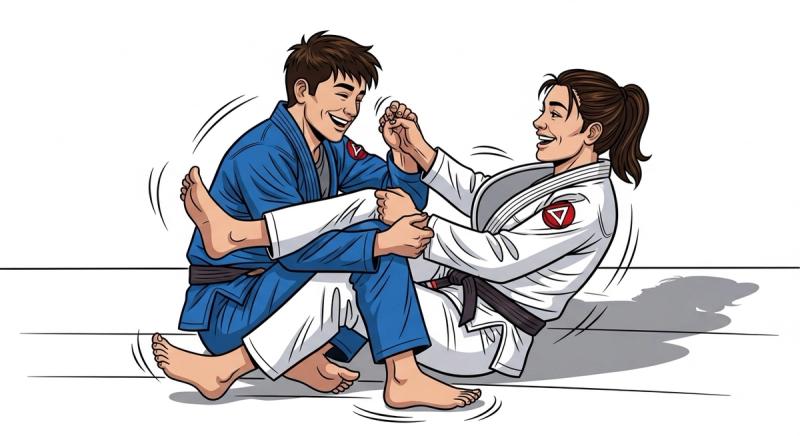

To everyone sweating it out on the mats every week — driven by that desire to get better and get stronger:
That mindset is the heart of jiu-jitsu. But if you want to enjoy this beautiful martial art for years — even decades — there’s one thing that must always come first.
Don’t get injured.
Jiu-jitsu is a contact sport, and unfortunately, the risk of injury cannot be eliminated. A single moment of carelessness or stubbornness can sideline you for months.
In this column, I’ll share practical ways to stay healthy — not just for today’s roll, but for a long, sustainable journey.
We’ll look at it from two angles: (1) how to act safely during training, and (2) how to build a solid mind and body off the mats.
During Training: The Rules That Keep You Safe
Most injuries happen during sparring — often from “pushing too far.”
Your choices on the mat determine how long your jiu-jitsu life will last.
1. The Most Important Habit: Tap Early, Tap Often
The single best way to prevent injuries is to tap early.
If your joint feels a little weird or tight — tap.
If you’re stuck in a choke and think, “I can still hold on…” — tap anyway.
A moment of pride isn’t worth months of rehab.
Joint injuries can take a long time to heal, and even mild chokes can cause lasting effects if you go out cold.
Remember: tapping in training isn’t losing — it’s longevity.
You’re not surrendering; you’re choosing to come back tomorrow.
And if you’re the one applying a submission — apply it slowly and with control. Giving your partner time to tap is part of the etiquette that defines a true martial artist.
2. Train With Technique, Not Muscle
Relying on brute strength not only makes your technique sloppy — it puts extra stress on your own joints.
- Relax your body.
Tension can lead to awkward and dangerous positions. Take a breath, loosen your shoulders, and flow. - Let technique do the work.
Precise, biomechanically sound movement isn’t just efficient — it’s safe.
Drilling the correct form under an instructor’s eye protects you better than any brace or tape ever could.
As Roger Gracie famously said:
“Jiu-jitsu isn’t about strength — it’s about smart technique. Learn how to control bigger opponents using leverage, timing, and body mechanics.”
People who spar with reasonable control are often the ones you trust most — both as training partners and as people.
If you roll only with reckless partners, you’ll end up in an endless loop of unnecessary injuries.
3. Be Smart About Sparring
Sparring is the heart of jiu-jitsu — but that doesn’t mean you have to go 100% every round.
- Choose partners wisely.
You don’t have to roll with everyone.
Avoid partners who use excessive force or fail to maintain control. Rolling with huge size differences can also increase the risk of accidental injury. - Know when to let go.
When your position is collapsing, don’t fight gravity.
Forcing your body into unnatural angles to “win” the round is a recipe for tweaks and tears.
Get passed, tap, reset — and attack again. That’s how you actually improve.
Off the Mat: Building a Body That Lasts
Your injury prevention starts before class — and continues after.
How you take care of yourself outside the dojo determines how long you’ll be able to train.
1. Make Pre- and Post-Class Care a Routine
- Warm up properly.
Don’t skip the drills or show up late.
Focus primarily on your shoulders, hips, and neck — the joints that take the most stress. - Cool down and ice.
A few minutes of stretching after class helps recovery.
If you feel even mild inflammation, ice it — don’t ignore it.
Tape or brace any weak spots before class if needed.
2. Build a Jiu-Jitsu-Proof Body
- Strengthen your core and neck.
Strong stabilizers reduce stress on joints. Even simple bodyweight exercises go a long way. - Learn proper breakfalls.
Being able to fall safely is essential. You’ll thank yourself the first time you get thrown hard. - Know your limits.
Through stretching and mobility exercises, you can assess your range of motion and pinpoint your areas of weakness.
That awareness will tell you when to tap — and prevent injuries before they happen.
3. Rest, Eat, and Recover
Ultimately, your lifestyle supports your training.
- Sleep well.
Muscles and nerves recover during deep sleep. Aim for 7–8 hours.
Fatigue and slow reactions are behind many avoidable injuries. - Eat smart.
Prioritize protein for repair and omega-3 fats to reduce inflammation.
Your body literally becomes what you feed it.
Final Thoughts: Longevity Is the Real Strength
The people who truly get strong in jiu-jitsu are the ones who keep showing up for years.
Getting submitted or passed won’t hurt you.
Getting injured might keep you off the mat for months.
In jiu-jitsu, not getting injured is a form of respect — for yourself and for your training partners.
When you roll with patience and self-control, you’re not being “soft” — you’re showing maturity as a martial artist.
Don’t get injured, don’t cause injuries.
Train safely, stay humble, and enjoy the journey — one step, one roll, one year at a time.
That’s how you find real strength in this art.