
Let me tell you honestly right up front: I am, without a doubt, a huge fan of Yutaka Saito! So, this article is an absolute abuse of authority on my part—I’m writing to praise Yutaka Saito as much as humanly possible. Just as a disclaimer, these are the opinions of a combat sports fan who has no MMA experience and is purely a spectator (I've never punched a person in my life!) while practicing grappling as a hobby. I’m also nowhere near technical enough to analyze detailed mechanics. Still, there were so many parts where I caught myself thinking, "Man, I want to pull off that top control in sparring...!", so please let me gush with all my love!
The spark that ignited this was watching RIZIN CONFESSIONS ("RI-CON"), the documentary series showing behind-the-scenes moments before and after fights. Seeing the fighters' resolve, their struggles, and the intense passion they poured into that match completely inspired me, and I thought, "As a grappling enthusiast, I just have to write about this!" Therefore, please forgive me in advance for the heavily Yutaka Saito-biased content of this article (haha).
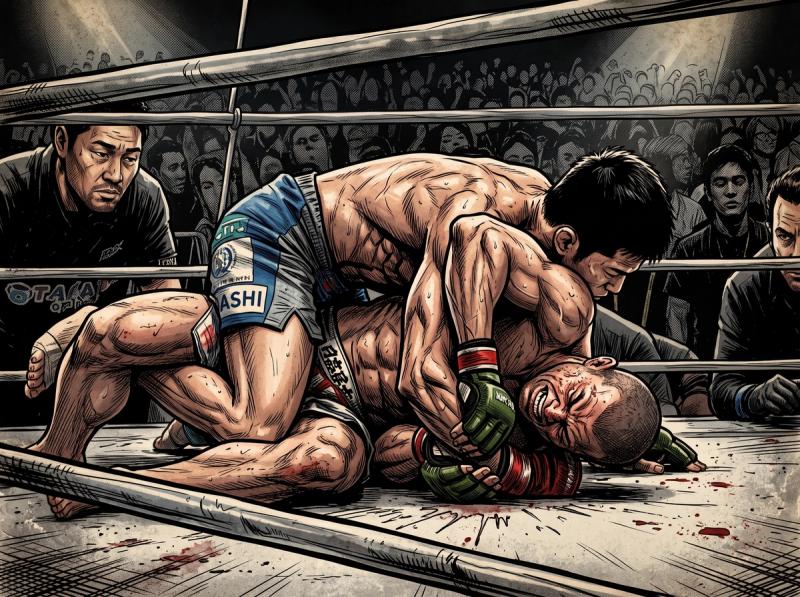
Now, the spotlight this time is on Yutaka Saito’s "position control" shown in his fight against YA-MAN. Even though it was an MMA fight, that ground battle was packed with takeaways for those of us in No-Gi grappling or Gi Jiu-Jitsu who struggle with issues like "losing top position immediately after getting it" or "having too light a pressure to control the opponent."
From a pure grappler's perspective, here are 3 key takeaways of Saito-style top control that we can "steal"!
Why We, Who Don't Punch People, Can Use This Fight as a Textbook
For pure grapplers, MMA ground fights need a bit of translation. There are strikes (ground-and-pound). You get hit if you get forced back to a stand-up position. There’s a cage. Because of all that, the value of "pinning" someone down looks much higher than under our rules.
Still, even after translating all of that, the core that remains is the same:
- Take a good position and don't give it up.
- When the opponent moves, use their momentum to advance to the next position.
- Even if a submission seems close, don't sacrifice your position to chase it.
Whether you have a gi on, whether there are points, or whether there are strikes, these three principles stay true. That’s exactly what Saito was doing in that fight.
The reason I got goosebumps at the dome as a spectator, and why my chest swelled with emotion two or three times rewatching RI-CON and match highlights, wasn't because of a flashy submission. It was because what I haven't been able to do in my own Jiu-Jitsu and grappling was being executed flawlessly for 15 straight minutes inside a professional ring.
Top Half Guard Is Not an Incomplete Position
There’s a common misconception among beginner and intermediate pure grapplers. It’s the idea that top half guard is just a stepping stone before mount or side control—a place where your job isn't finished yet.
A leg is still trapped. You haven't passed. You get no points. So you rush to free your knee. If it doesn't come out, you force a submission hunt. Then the opponent builds a frame, raises a knee from the bottom, and before you know it, you’re stuck back in full guard.
Saito’s half guard wasn't just a transition. It was the control center.
His landing position from the takedown was almost identical every single time: half guard, having cleared YA-MAN's right leg. He would land there, flatten his upper body, and pin him. He shut down the chest and shoulders before worrying about the legs. He didn't let YA-MAN push his face away to create distance.
This is 100% applicable to pure grappling. In fact, it’s even more effective in No-Gi, where there are no gis. Without sleeves to hold you back, all that's left is tight connection and angles.
If you struggle with "not being able to pass" in sparring, look at your chest before looking at your legs. Is your opponent's elbow framing up? Is your weight resting on their upper body instead of their hips?
Saito kept advancing the fight even with his leg trapped. If the bottom person's upper body is immobilized, they can’t sweep, stand up, or rebuild their guard. Half guard isn't incomplete—it can be the ultimate position for shutting down the upper body.
If you want to try this on the mats tomorrow, here’s how: the moment you land in "at least half guard" during a takedown or pass, don't rush the knee slice. Flatten their upper body for just 10 seconds. Only after doing that should you move your knee. Just doing that will make your usual guard pass a lot easier.
The Opponent's Escape Isn't an Obstacle—It’s a Trigger to the Next Position
It's not that YA-MAN was doing nothing on the bottom. He pushed the face, bridged, and tried to stand up. From a grappler's perspective, these were all correct initial reactions.
When the bottom person uses power to move, beginner/intermediate top players desperately try to stop it. They dump their weight, stiff-arm, and treat the opponent's movement like an unexpected accident.
Saito was different. When the opponent moved, he rode that momentum into the next position.
- Tries to create space → Flattened back into tight connection
- Tries to sweep with a bridge → Back taken using that rotational force
- Tries to stand up → Space erased and brought right back to the mat
The back take late in Round 1 was the clearest example. A bridge from the bottom is a force intended to sweep. For a skilled top player, it’s also the momentum needed to take the back.
In pure grappling sparring, this is often the #1 cause of failure. You likely think you failed the moment your pass gets stopped. The moment the person on the bottom explodes, you panic thinking "I got off-balanced!" right? But actually, that’s where your real work begins.
Use the direction of the power your opponent outputs to drive your own movement. Don't block it—ride it.
Strong top players do the exact same thing in both Jiu-Jitsu and grappling. Saito maintained this for 15 solid minutes on top of a dangerous opponent like YA-MAN. I praise him completely—that wasn't a lucky fluke, it was position design.
Don't Rush for the Submission and Give Up Position
As a spectator, the most heart-pounding moment was when the rear-naked choke was almost locked in. I yelled, "GO FOR IT!" at the top of my lungs. Not in my head, but out loud—because I'm a fight nerd.
Yet when it didn't sink in completely, Saito returned to the top. If he was about to lose the back, he didn't force the chase; he slipped right back into top half guard.
Rewatching the fight, I was even more moved than on the day of the event by the cold composure of that decision. There was something there that I couldn't see through the fog of excitement.
Beginner grapplers tend to overlook this judgment. That’s because in our matches, submission is king. If you take the back, you choke; if you get mount, you look for an armbar. If the bottom player scrambles, you roll with them chasing a submission.
I get that feeling—I really do. But sacrificing position for a rushed submission attempt is the most expensive mistake you can make in both sparring and competition.
This is especially true in No-Gi. Without a gi, recovering once you lose a good position is brutal. You don't have the insurance policy of grabbing a sleeve to stall. That’s why asking yourself, "Am I currently in a winning position?" is the offense.
Saito knew the winning position. And he didn't step down from it.
Please don't write this off as "something only necessary for MMA." Even in pure grappling, someone who stays in a winning position is insanely strong. Someone who rushes a submission and falls back into the guard will always be stuck in the same place.
What We, Who Don't Punch, Should Take Away Tomorrow
You don't need to copy the strikes. The cage and ground-and-pound aren't the subjects of this article. What we take home are pure ground-game habits:
In top half guard, flatten the upper body before worrying about the legs. On days you can't pass, it's usually not a lack of leg-passing technique; it's that the opponent's frames are alive. Weight the chest, collapse their elbows, erase the head space. Don't treat those 10 seconds as empty time.
When the opponent uses power, ride it instead of stopping it. Bridges, shoulder escapes, standing attempts—view them all not as "nuisances," but as triggers to the next position. If you're on the bottom, don't use your strength sloppily. A good top player is waiting for that exact energy.
Don't abandon your position just before a submission. Back and mount aren't mere stepping stones to a submission. Being there is the win. If it's close but not locking in, reset. Go claim the same dominant position again. Saito executed this relentlessly. That’s why it was so beautiful.
I have never punched anyone. I have never stepped into a ring. Yet that position control felt like a story from my own mats.
The strength to stay in a good position isn't about standing still. It’s the strength to never step down.
I felt the same 15 minutes of deep emotion at Kyocera Dome once, and again through RI-CON. If fellow pure grapplers remember just one thing during your next sparring session, before any technique name, this is more than enough:
"Am I currently in a winning position?"
If you are, do not step down.
Summary
As I said at the beginning, I’m a huge fan of Yutaka Saito. And as a fellow grappling enthusiast, watching that relentless and precise control gets me so excited thinking, "I want to apply that kind of insane pressure on the mats too...!"
Even in scenes that look like quiet pinning on the surface, there was a high-level grappling war condensed inside—smothering frames, weight distribution, and millimeter-level tightening.
If you always struggle with top control in sparring or constantly get escaped by your opponent's hip escapes, give RI-CON or the fight footage another watch!
In Yutaka Saito’s methods of erasing space and shutting down the hips, there are golden hints that can dramatically change our daily grappling!