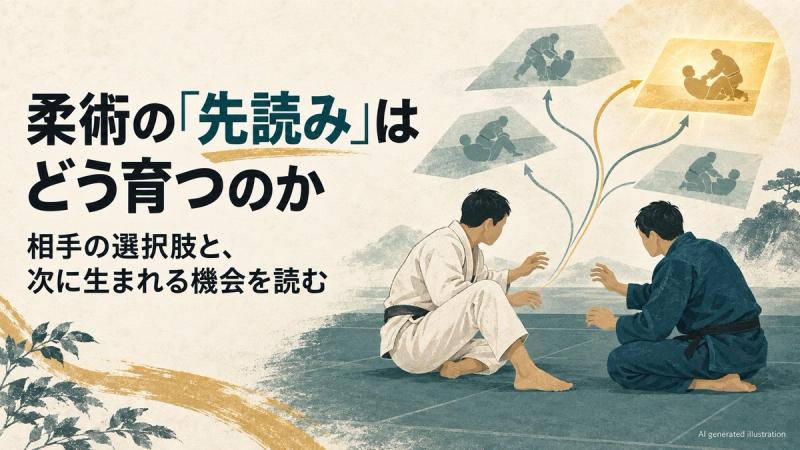

An opponent starts moving, and the response is already underway. Some of the speed we experience in jiu-jitsu comes from anticipation: recognizing what is likely to happen before it fully unfolds.
In an Instagram post, John Danaher emphasizes the value of anticipating an opponent’s movements alongside the ability to react quickly. What makes anticipation possible, and how can training develop it?[1]
Fewer options make the next move easier to read
Danaher’s explanation begins with recurring problems and the limited number of effective responses to them. A position may appear to offer countless possibilities, but only some responses work reliably. Narrow the field to the highest-percentage options, and the number shrinks further. This makes sound prediction a skill that practitioners can develop through training.[1]
In episode 31 of BJJ Mental Models, “Predictable Responses,” Steve and Matt Kwan explain how grapplers can actively narrow those options. When an opponent can move freely, there are many possibilities to consider. Establishing particular grips and moving the opponent can restrict their choices and make certain responses more likely. That reduces the number of reactions the attacker needs to prepare for.[2]
Gordon Ryan’s Instagram explanation of a mount exchange provides a concrete example.
According to Ryan, he was already considering his opponent’s potential mount escapes while the guard-passing sequence was still underway. He identified several possibilities: sitting up, turning to expose the back, kipping, or attempting a knee-elbow escape. He explained that his head position had already shut down the option of sitting up.[3]
When his opponent used a hand to push his knee toward half guard, Ryan was ready to underhook the arm and move it above the opponent’s head. He began preparing his escape during the transition into mount.[3]
Anticipation and positioning work together here. Ryan identifies the available responses and uses his position to make some of them harder, allowing him to prepare for those that remain. As Danaher argues, reliably reading the next one or two moves can provide a substantial advantage.[1], [3]
Your actions help create the next opportunity
Anticipation also involves using the responses that your own actions make more likely.
In episode 31, the Kwans explain that an initial attack can loosen a grip or disturb an opponent’s balance even when it does not succeed outright. Those changes can improve the conditions for a subsequent attack. Ending the exchange as soon as the first technique is defended can mean overlooking the opportunity created by that defense.[2]
Margot Ciccarelli offers a related example in episode 377, “Presence & Anticipation.” Pulling an opponent’s arm may prompt them to pull it back, opening space between their elbow and rib cage. The initial pull becomes a way to anticipate—and help create—the next available space.[4]
Attention therefore extends from the opponent’s current position to how that position may change through the interaction. Ciccarelli describes considering how long a space will remain open, whether she can enter it, and whether she can establish a connection that allows her to stay there.[4]
This gives technique combinations a practical meaning beyond their sequence. What did the first attack make the opponent do? What became available as a result? Episode 31’s discussion of predictable responses and Ciccarelli’s explanation of space describe this relationship from different angles.[2], [4]
Keep observing while you anticipate
Knowing a likely response does not guarantee that an opponent will produce it.
In episode 31, Matt Kwan stresses that initiating attacks must be accompanied by recognizing when the expected response actually occurs. Creating a reaction and remaining receptive to the opponent’s movement are both necessary.[2]
Ciccarelli’s emphasis on being present connects directly to this requirement. Awareness of an opponent’s body position and the surrounding space supplies information for anticipating what may happen next. Conversely, getting caught up in an imagined trap can obscure an opportunity that already exists. She recalls a training partner interpreting her inactivity as a trap even though she was not setting one.[4]
Continued observation lets you revise a prediction. Comparing the response you expected with the one your opponent actually produced helps turn anticipation into a usable skill.
Build training around the interaction
Danaher recommends observing recurring patterns of success and failure, then using sparring to test whether those patterns hold up.[1] Episode 31 similarly describes an incremental process: understanding a technique’s mechanics, learning its common defenses, and refining that knowledge through experience.[2]
How can training make those experiences more accessible? Greg Souders’ approach to practice design offers one example.
In an interview on The Sonny Brown Breakdown, Souders describes a game beginning in chest-to-chest half guard. The top player’s task is to stay on top, hold the opponent’s chest down, and free the trapped leg. Bringing the knee out toward either mount or side control satisfies the game’s objective.[5]
Souders emphasizes using information from the opponent’s body to adjust movement while working toward the task.[5] Viewed through the question of anticipation, this creates opportunities to experience an action, the opponent’s response, and the resulting opening as a connected exchange.
Ciccarelli also discusses incorporating ecological games into her seminars after training with Souders. She describes directing attention toward a concrete effect—such as making an opponent place their hands on the mat. In her experience, these tasks help students remain engaged with the unfolding exchange instead of becoming absorbed in recalling the next step of a technique.[4]
She also describes slowing down exchanges in her own practice while preserving the interaction between partners. When normal speed leaves too little time to recognize what is happening, a slower exchange provides more time to explore. She presents this as a way to develop anticipation that can eventually operate at higher speeds.[4]
These accounts do not explain learning through an identical theoretical framework. Together, however, they suggest a useful focus for practice: experiencing your action, your opponent’s response, and the next available opportunity as connected events.
Alongside asking whether a technique worked, ask what it made your opponent do and what opened as a result. Those small changes in everyday exchanges provide the material for reading the next move.
Conclusion
Anticipation grows from understanding the options a position allows, influencing an opponent’s responses, and recognizing what actually happens. Danaher’s focus on recurring patterns, Ryan’s preparation for escapes, and the BJJ Mental Models discussions connect these parts of the skill.[1]–[4]
The practical lesson is to pay attention to the relationship between exchanges: what your action prompted, what opportunity appeared, and whether your expectation matched the response. Training can make those relationships easier to explore through focused tasks and manageable pacing.[4], [5] Each exchange then becomes an opportunity to refine your understanding—and arrive better prepared for the next move.
Sources
[1] J. Danaher, “It’s good to be able to react quickly to an opponents moves,” Instagram, Aug. 26, 2026. [Online]. Available: Original post.
[2] S. Kwan and M. Kwan, “Ep. 31: Predictable Responses,” BJJ Mental Models, podcast, Aug. 5, 2019. [Online]. Available: Official episode page.
[3] G. Ryan, “Anticipation—knowing what moves are possible before they happen,” Instagram, May 22, 2024. [Online]. Available: Original post.
[4] S. Kwan and M. Ciccarelli, “Ep. 377: Presence & Anticipation, feat. Margot Ciccarelli,” BJJ Mental Models, podcast, Feb. 16, 2026. [Online]. Available: Official episode page.
[5] S. Brown, “Greg Souders On Teaching Jiu-Jitsu Without Teaching Techniques,” The Sonny Brown Breakdown, interview with G. Souders, Dec. 9, 2022. [Online]. Available: Official interview page.