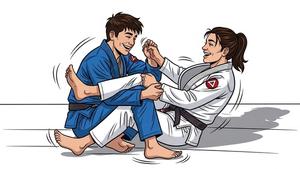

Brazilian Jiu-Jitsu (BJJ) is now practiced around the world, not only as a competitive sport but also through MMA, fitness, and self-defense.
Its global growth is often explained through the idea that a smaller person can control or defeat a larger opponent, or through the technical effectiveness of its ground game.
But Robert Drysdale, an ADCC champion who has also spent years researching jiu-jitsu history, argues that technique alone does not explain BJJ’s global success.[1]
Technique Alone Does Not Explain BJJ’s Growth
In an interview with The MMA Lab, Drysdale argued that many techniques used in BJJ also exist in catch wrestling, sambo, Kosen judo, and judo.[1]
He said:
“People think jiu-jitsu is popular because of the technique. That’s nonsense.”
His point is not that BJJ technique is ineffective. Rather, he argues that the effectiveness of the techniques and the reasons BJJ spread more widely than other grappling systems are separate questions.[1]
The Importance of “Copacabana Culture”
One factor Drysdale emphasizes is the culture that developed around BJJ in Brazil.
He points in particular to Carlson Gracie, who he says helped bring a more relaxed, beach-influenced social atmosphere onto the mats.[1]
Instead of a purely strict martial arts environment, training could include joking with teammates, socializing after class, and maintaining a less formal atmosphere while still training hard.
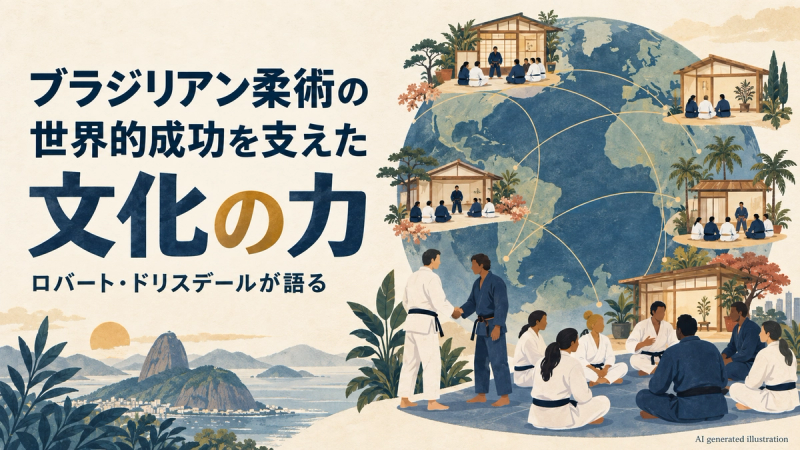
Drysdale calls this “Copacabana culture” and argues that this social environment became part of what BJJ exported around the world.[1]
In that sense, BJJ did not only spread a technical system. It also spread a particular way of learning, training, and interacting within the gym.
Research Also Points to BJJ’s Social Dimension
No research directly proves Drysdale’s historical argument, but academic work on BJJ identifies similar social characteristics.
A 2021 systematic review by Tony Blomqvist Mickelsson analyzed 12 studies on the social and psychological aspects of BJJ. The review found recurring themes around resilience, social bonding, peer relationships, and the social environment of BJJ gyms.[2]
In particular, coaches and training partners appear to play an important role in shaping the training experience, while the physical challenge of sparring may strengthen social bonds.[2]
BJJ is therefore unusual in that training partners compete against each other while also depending on each other to improve.
That combination of competition and cooperation may be an important part of how BJJ communities form.
Hard Training and Playfulness
The social side of BJJ also appears in Holly McClung Reusing's work.
Her doctoral research, based on interviews with five BJJ black belt instructors, described BJJ practice as being associated with playfulness, teamwork, social values, and a safe learning environment.[3]
This creates an interesting contrast.
BJJ can be physically demanding and uncomfortable, yet the gym environment can also be friendly, cooperative, and informal.
That overlaps with Drysdale’s description of “Copacabana culture.”
MMA Helped Introduce BJJ to the World
MMA also played a major role in BJJ’s international growth.
Mickelsson’s review identifies the early UFC and the Gracie family’s success as major factors in generating global interest in BJJ.[2]
Watching a smaller fighter control and submit larger opponents clearly demonstrated BJJ’s practical effectiveness.
As MMA developed, learning BJJ also became increasingly important for fighters who wanted to compete successfully.[2]
However, MMA may explain how many people first discovered BJJ, rather than why they continued training for years.
Community, training relationships, and the social side of practice may also help explain retention.
Looking Beyond Technique
Sports science research confirms that BJJ is physically demanding. It is an intermittent combat sport requiring strength, muscular endurance, power, flexibility, and conditioning.[4]
Technical and physical ability matter. But that doesn’t explain why BJJ became more globally widespread than other grappling systems.
Judo, sambo, and catch wrestling also possess sophisticated grappling techniques.
To understand BJJ’s expansion, it may be necessary to look at several factors together: MMA exposure, live sparring, gym culture, social relationships, playfulness, and the way BJJ communities are organized.
Drysdale’s idea of “Copacabana culture” should therefore be understood as one explanation for the cultural side of BJJ’s growth, rather than as a proven single cause.
BJJ may have exported more than chokes and joint locks.
It may also have exported a particular culture of how people train, learn, and spend time together on the mats.
References
[1] Robert Drysdale Interview — The MMA Lab
[2] Blomqvist Mickelsson, T. (2021). Brazilian jiu-jitsu as social and psychological therapy: a systematic review. Journal of Physical Education and Sport, 21(3), 1544–1552.
[3] Reusing, H. M. (2014). The Language of Martial Arts: The Transformative Potential of Brazilian Jiu-Jitsu through the Lens of Depth Psychology. Doctoral dissertation, Pacifica Graduate Institute.
[4] Andreato, L. V., Díaz Lara, F. J., Andrade, A., & Branco, B. H. M. (2017). Physical and Physiological Profiles of Brazilian Jiu-Jitsu Athletes: a Systematic Review. Sports Medicine - Open, 3, 9.